We use cookies to personalise and enhance your experience on this site. By clicking Accept or continuing to use the site, you agree to our use of marketing and social media cookies as described in our Privacy Policy.
Accept and close
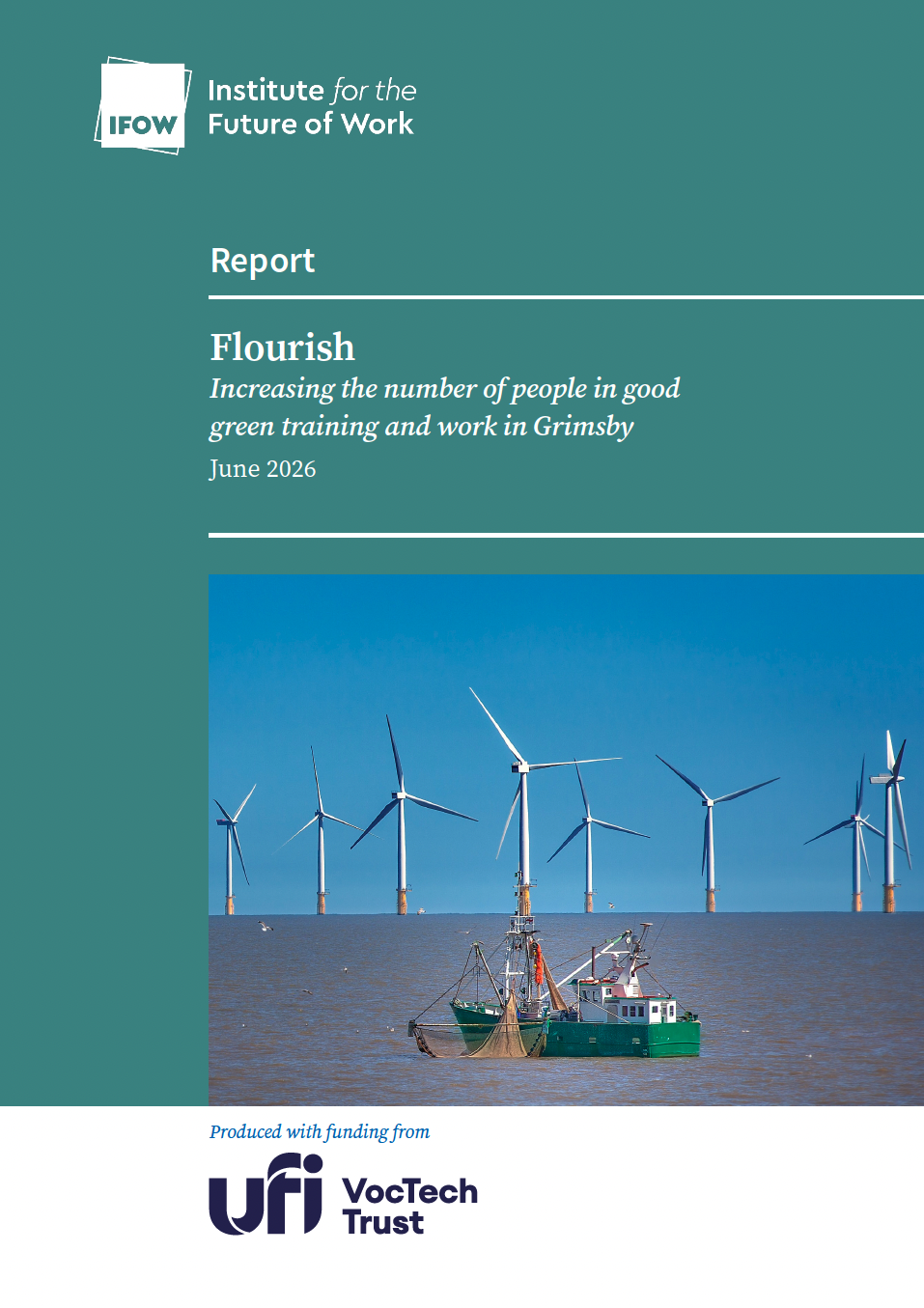
This report provides a strategic analysis of the first-year findings from the Flourish project in Grimsby, a research-impact initiative led by the Institute for the Future of Work (IFOW) in partnership with East Marsh United. Against the backdrop of a net-zero economy that is growing ten times faster than the wider UK economy, Grimsby has emerged as a global hub for offshore wind, already providing 3% of the UK’s energy.
Moving beyond traditional vocational training, the report adopts a “capabilities approach” rooted in the Aristotelian concept of eudaimonia (human flourishing). It examines the specific local “conversion factors” required for individuals in post-industrial regions to turn skills into good work that they genuinely have reason to value.
The research is grounded in a participatory, design-led methodology centred on the lived experiences of community researchers who have lived experience of being NEET (16–24 year olds who are Not in Employment, Education, or Training). Through 46 in-depth interviews and extensive stakeholder mapping, the project identifies five systemic challenges specific to the Grimsby context:
To address these challenges, the report sets out a series of actionable policy recommendations and introduces the development of the Flourish technology platform, co-designed to help users identify intrinsic motivations and navigate local pathways. Key proposals include regulating “ghost vacancies” to restore labour market transparency, adopting a “No Wrong Door” support model inspired by Grimsby’s Careers Café, and formalising sector-specific employer networks to enable SMEs to offer high-quality apprenticeships.
Ultimately, the report argues that a Grimsby's green transition must be an active and inclusive process - ensuring the shift to net zero is built with and for the people of Grimsby, where technology and policy work together to support dignity, autonomy, and good work for everyone.
Grimsby Community Research Team: Joana Geisler, Oliver Nash, Oli Whittington, Tracy Slattery, and Juthika, Liv, and Zaine.
Report
Changing work